Vaping is becoming more popular and the number of defective vape pens has increased. This has resulted in serious injuries and health risks. Vape pens that contain toxic chemicals or explode due to faulty batteries can cause serious health problems, including burns and respiratory issues. Understanding their legal options can be crucial for victims of defective vape pen injuries who are seeking compensation. This guide will help you understand your legal options if a defective vape pen has caused you harm.
Product Liability Lawsuits
Victims of defective vape pens are most likely to file a product liability lawsuit. These cases can be brought against the retailer, manufacturer, or distributor for selling a defective or dangerous product. Product liability cases are typically divided into three main categories:
Design Defects: A vape pen could have a design flaw, like a battery that is prone to overheating.
Manufacturing Defects: A defect during the production process can result in defective components such as a battery that is not properly sealed or materials of inferior quality.
Failure to warn: The manufacturer could have failed to give adequate instructions or warnings about possible risks such as battery explosions and overheating.
You must prove the defective nature of the vape pen, the injury it caused, and the fact that you used the product in the intended manner to win a case for product liability.
Negligence Claims
Victims may also file negligence claims in addition to product liability against the companies that produced or distributed the vape pen. Negligence is when a company does not exercise reasonable care while designing, manufacturing, or selling a particular product. If a company ignores safety protocols or fails to test a vape pen, it could be held responsible for any injuries that result from its negligence.
Compensation You Can Seek
If a defective vape pen is found, victims can claim compensation for:
Medical Expenses (hospital bills and rehabilitation, future medical treatment)
Lost Wages (income loss due to injury, or recovery time).
Pain & suffering (emotional & physical trauma)
Punitive damages
You have options to pursue justice if you were injured by a defective vaporizer. Understanding your rights will help you to recover compensation for your injuries, and hold responsible parties accountable. Consult a personal attorney who is experienced in defective product claims to help you navigate the legal process.
Lee Clark & Associates is a dedicated law firm based in Lakewood Ranch, FL, specializing in personal injury, slip and fall injury attorneys near you, mass torts, defective product lawyer near you, tobacco and Defective Vape pen injury attorney Bradenton FL, and wrongful death attorney in Florida. With extensive experience and a client-first approach, the firm proudly serves clients throughout Manatee, Sarasota, Polk, Hillsborough, and Pinellas counties. Whether you’ve been injured due to a defective product or are seeking justice for the wrongful death of a loved one, W. W. Lee Clark & Associates provides the guidance and legal representation you need to protect your rights and pursue compensation. Schedule your consultation today!
Social networks are experiencing a colossal cliff in the US. Their company product has been singled out by a tsunami of lawsuits from individuals, educational institutions and public prosecutors. They accuse the platforms of consciously damaging the psychological overall health of youthful persons. And not just because of the articles they support disseminate: the extremely design and style of the solution, the claimants argue, seeks habit in order to ensnare the user. The much more time men and women shell out hooked to the display, the larger the financial gains from advertising. This vicious circle, the lawsuits argue, is owning awful consequences on young children and young people, who suffer from melancholy, ingesting disorders or even suicidal tendencies.
A 16-calendar year-aged Utah female will become so obsessed with her entire body image just after obtaining hooked on Instagram that she develops anorexia and bulimia. A nine-12 months-outdated Michigan boy spends so lots of evenings observing YouTube, TikTok and Snapchat videos that he finishes up uploading a nude photograph of himself that goes viral. An 11-calendar year-outdated Connecticut female promotions for two a long time with an extreme habit to Instagram and Snapchat just before spiraling into sleeplessness and depression that prospects her to choose her possess life. These harrowing instances, described past year by Bloomberg, are amongst hundreds of non-public lawsuits submitted towards social networks in modern months.
Two hundred of them have joined jointly in a class-action lawsuit. Filed in the Northern District of California in March, the lawsuit expenses that Meta (for Facebook and Instagram), Snap (for Snapchat), ByteDance (the company that owns TikTok) and Google (for YouTube) are significantly harming the mental health of young People in america. The procedure is presently in the pleadings section. The U.S. Supreme Courtroom is due to make your mind up in June whether the lawsuit goes forward or is dismissed.
This newspaper has contacted the four technological innovation firms to inquire about their situation on the course of action. All of them have declined to remark precisely on the lawsuit, over and above assuring that they are taking methods to bolster articles command. “We have made extra than 30 equipment to assist teenagers and their people, like characteristics that permit moms and dads to determine when and for how very long their children can use Instagram,” notes, for example, Antigone Davis, global director of Meta Protection. The firm led by Mark Zuckerberg has just attained an out-of-courtroom settlement to compensate buyers of Facebook whose knowledge was leaked to Cambridge Analytica with 725 million bucks.
“Our situation does not just look at the information of the platforms, the problem is further than that. We allude to the really design of the social networks: from the age verification methods, or the lack of them, to diverse attributes of the platform by itself that, we argue, ended up specifically built to be addictive,” Joseph VanZandt, of the Beasley Allen agency, clarifies to EL PAÍS by videoconference. VanZandt leads the authorized counsel coordinating the course action lawsuit, which entails two other legislation companies and numerous private attorneys.
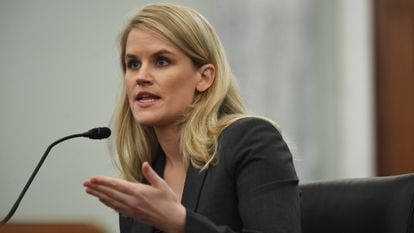
Previous Fb staff Frances Haugen appeared in October 2021 just before a U.S. Senate subcommittee in the wake of the tech company’s doc leak.Pool (Getty Images)
“Everything from the way videos and posts are exhibited and organized, to the style and placement of buttons, is developed to foster addiction and retain customers coming back to the platform once more and again,” VanZandt argues. “In addition to the style of social networks themselves, the need impacts how the platforms’ algorithms do the job. They are developed to give more traction to written content that raises interactions and engagement on the platform. All with the purpose of escalating marketing revenue,” he stresses. “To examination this, we are performing with a wide network of professionals who argue how these springs operate, as nicely as the impact they have on young persons. We are self-confident in our means to be able to prove that our consumers are currently being harmed by these items.”
A tsunami of lawsuits
The first scenario approved by VanZadt’s staff was that of Brianna Murden, a 21-year-aged who began working with social networks at the age of 10. “After yrs of publicity to content from numerous platforms selected by algorithms, subjected to a torrent of notifications 24 hrs a day, [the networks] have induced her despair, sleeplessness and eating disorders, amid other folks.” In August previous calendar year, they submitted a lawsuit from Meta and other platforms. A several months later, they experienced dozens of comparable petitions. The identical issue happened in other offices. The torrent of lawsuits soon became a tsunami. For this reason, they resolved to file a class motion lawsuit.
California’s is not the only lawsuit filed in opposition to social networks over this situation. In January of this 12 months, Seattle General public Educational facilities sued TikTok, Facebook, Instagram, YouTube and Snapchat, pointing to them as responsible for ruining the psychological health and fitness of teenagers. It was the initially time a general public institution took legal motion towards social networks. Right after the Seattle college establishment arrived people of New Jersey, Florida or Pennsylvania. Very similar proceedings have also been initiated by the attorneys normal of Indiana or Arkansas, amongst other folks. “At this price, it would seem that social networks will encounter lawsuits in each and every condition in the state,” reported Jim Steyer, president of Common Feeling Media, a well-acknowledged NGO that evaluates the affect of technology and media on children.
The short from the Seattle schools, which stand for more than 100 colleges with some 50,000 pupils, argues that the algorithms of these platforms are displaying younger Americans probably destructive material and resulting in unsafe emotional impacts. It is also reported that victims of social networks with “severe addiction” can be affected by “mental and physical problems.” The lawsuit statements that schools are not able to appropriately educate young children for the reason that of social media addiction and relevant repercussions.
A group of female college students at a higher school in Austin, Texas, run their tablets in class.Bob Daemmrich (Corbis by means of Getty Illustrations or photos)
“We want these companies to be held accountable for their actions and the destruction they are creating. Not only to the pupils, but also to Seattle Community Colleges, which has to bear the operational stress and raising prices attributable to this mental wellbeing disaster,” Greg C. Narver, head of the legal section of the educational establishment, tells this newspaper. Those expenses contain employing psychologists, specific schooling for school, updating textbooks, and restitution of house harmed by “emotionally disturbed” pupils.
“We are unable to give a concrete determine of how a lot of students at present have mental issues. Nonetheless, we have skilled a sharp maximize in requests from colleges and college students for psychological health-related companies,” Narver provides.
The elephant in the home of social media
Numerous reports attest to the worsening psychological health of young Us citizens. A modern report by the country’s countrywide community wellbeing company certifies that “the psychological health and fitness of pupils proceeds to worsen”, and that numerous “feel so undesirable or hopeless that they can not carry out their every day activities normally”. The class action lawsuit and these filed by academic establishments cite dozens of scientific articles or blog posts that accredit the partnership in between the intense use of social networks and specified mental complications: from stress, melancholy, sleeplessness, having conditions or cyberbullying to self-harm and suicide. A United kingdom court docket dominated last calendar year for the to start with time that social networks were powering a youthful female having her very own daily life. The Condition of Utah, governed by Republican Spencer Cox, has made a decision to restrict the use of social networks amid minors, who will require parental consent to use them and will not have them energetic from 10.30 pm to 6.30 am.
For several years, the result of platforms on mental health and fitness was overlooked. It was an elephant in the place that is quickly out in the open up. This was served by Frances Haugen, the previous Fb staff who leaked hundreds of official documents to The Wall Street Journal and fueled one particular of the greatest journalistic investigations in the latest situations, released all through September 2021. The papers showed that the tech executives were being aware that Facebook and Instagram algorithms were being spreading amid young people, specifically women, the goodness of anorexia or even suicidal ideas. According to the technologies company’s personal exploration, 6{c024931d10daf6b71b41321fa9ba9cd89123fb34a4039ac9f079a256e3c1e6e8} of American adolescents and 13{c024931d10daf6b71b41321fa9ba9cd89123fb34a4039ac9f079a256e3c1e6e8} of British youngsters who mentioned they had viewed as suicide have been prompted to do so by Instagram.
“We count on our scenario to be justified, in no modest aspect, by the defendants’ have paperwork and by the testimony of workers and previous workforce of the platforms,” Narver acknowledges, alluding to Haugen’s papers. “She was the trigger. Her revelations served us understand how big the difficulty definitely is. A lot of families then understood what was occurring to their young children,” stresses VanZandt.
For the U.S. lawyer, the wave of lawsuits towards social networks resembles the lawsuits suffered by tobacco corporations in the 1990s. “The analogy is proper due to the fact of their procedural similarities, but also since the documents unveiled by Haugen counsel that Facebook executives understood the extent to which their products could be harmful”.
A sophisticated process
Will the lawsuits filed towards the major networks prosper? “I really don’t know if it has any lawful standing, but what I do know is that it is a wake-up call. Until eventually now, the design of social networks was still left totally in the arms of private companies. Now we see that they can have repercussions on mental wellbeing and, thus, we have to correct the system,” claims Sergio Juan-Creix, a attorney and specialist in digital legislation and professor at the UOC.
1 of the keys to the circumstance will be to see if the Supreme Courtroom considers that the platforms can avail them selves of section 230 of the Communications Decency Act of 1996, which exempts technology businesses, with couple exceptions, from legal responsibility for written content printed on them by third parties. “The plaintiff will have to show that there is a connection involving the options of the platform, the activities they permit and the harm to the psychological overall health of younger folks. I don’t assume it will be uncomplicated to establish,” considers Rodrigo Cetina, professor of law at the Barcelona Faculty of Administration, the business enterprise university of the Universitat Pompeu Fabra.
To day, the courts have stopped quite a few lawsuits in opposition to social networks when they relied on Area 230. Just one scenario, Gonzalez V. Google, is due to be solved in June or July, which will examination the Supreme Court’s interpretation of this post. The fit was brought by the spouse and children of an American female killed in the Bataclan assault in Paris. The plaintiffs allege that exposure to YouTube radicalized the terrorists, eventually redounding in the assault that led to the younger woman’s dying.
“The Gonzalez V. Google ruling will be significant in our method, but not definitive, because we go further than articles: we argue that, like slot devices, social networks are created to be addictive. And that this involves a collection of harms of which their creators are knowledgeable,” suggests VanZandt.
Indication up for our weekly newsletter to get much more English-language information coverage from EL PAÍS United states of america Version
Scott Norris Johnson, a quadriplegic lawyer who for 20 years sued thousands of California businesses over access for the disabled, was sentenced Tuesday in a Sacramento courtroom to 18 months of home detention and $250,000 in restitution after pleading guilty to filing a false tax return.
But the sentencing came only after Senior U.S. District Judge John A. Mendez insisted that Johnson face a fine for his behavior, a requirement that had not been included in the plea agreement between the prosecution and Johnson defense attorney Malcolm Segal.
“I think he should pay a significant fine given his financial condition, how much money he has,” Mendez said.
The judge said Johnson has $1.3 million in assets and a monthly income of more than $81,000, and he added that if not for Johnson’s serious medical requirements he would be facing a prison sentence.
“It’s significant enough conduct and a breach of trust, especially for a member of the Bar, that a prison term would be appropriate,” Mendez said.
Segal argued that despite Johnson’s financial holdings, much of it will be exhausted as Johnson faces monthly medical expenses of $26,000.
Mendez offered to put off sentencing so that a new agreement could be reached, but Johnson agreed to the $50,000 fine Mendez wanted, which was more than double the $20,000 fine recommended by probation officials.
The judge also ordered Johnson to face location monitoring and to have his annual tax returns reviewed by a certified public accountant and handed over to probation officials.
Most significantly, Mendez ordered Johnson not to seek out violations of the Americans with Disabilities Act and not to file lawsuits in federal or state courts against businesses that may be in violation of the ADA while he is in home detention.
The judge added that he did not consider Johnson, a former IRS worker, to be remorseful.
“Honestly, Mr. Johnson, I don’t see a great deal of remorse in your statement,” Mendez said. “That concerns me.
“I’m not sure why you felt entitled to defraud the IRS, especially given your background. You should have known better.”
Serial ADA lawsuit filer Scott Johnson leaves his 2019 visual appearance right after currently being indicted on tax costs in Sacramento. On Tuesday, Johnson was sentenced to 18 months household confinement, $250,000 in restitution and $50,000 in fines for his responsible plea. Paul Kitagaki Jr. Sacramento Bee file
Johnson, seated in a wheelchair at the defense table accompanied by his service dog, responded by saying, “I am truly sorry that I am here because of my taxes. I’m sorry.”
“Well, you’re here because you decided to defraud the United States,” Mendez replied.
Johnson could have faced a sentence of up to three years in prison.
Johnson’s sentence stems from a three-count tax indictment by a federal grand jury and follows his guilty plea last November to one count of filing a false tax return from the 2012 tax year.
His license to practice law was suspended following his guilty plea, and he was ordered not to seek reinstatement while under the 30 months of probation imposed by Mendez, who made it clear he was unhappy with the fact that Johnson had not voluntarily resigned from the Bar.
His 2019 indictment sparked unbridled joy among some of the business owners he sued alleging violations of the Americans with Disabilities Act.
The ADA became law in 1990 and still generates debate between disability advocates who say businesses have had ample time to adhere to the law and business owners who contend attorneys like Johnson conducted drive-bys of their locations without actually intending to patronize them.
Johnson, a Carmichael resident, was a subject of a 2006 Sacramento Bee investigation, “The Price of Access,” that described how he and other disability attorneys used their suits to bring businesses into compliance while also generating thousands of dollars in settlement payouts from small business owners.
His reporting of that income to the IRS eventually led to the indictment, court papers say.
“For the years 2012 through 2014, Johnson willfully failed to report a portion of the settlement payments he received as income on his tax returns,” according to the plea agreement filed in court.
Segal wrote in a court filing that Johnson’s lawsuits were part of his determination to see that businesses provided access to the disabled.
“That method of enforcement was planned by the drafters of the legislation to bring businesses into compliance,” Segal wrote.
Johnson has been disabled since 1981, when a co-worker driving with Johnson as a passenger struck an office building pillar, Segal wrote.
Despite his physical limitations, Johnson graduated from college, became an attorney and started a family, but “suffered a substantial setback” in the 1990s while he was working at his job in the Internal Revenue Service office on Watt Avenue, Segal wrote.
“On what had been a typical workday afternoon, he decided to have lunch at a nearby and busy fast-food business frequented by other employees in the building who generally used a well-worn path to get to the front entrance.
“There was no planned access for people using a wheelchair or with other physical limitations. To get to the restaurant, he entered a driveway to wheel his chair down to the front entrance, and while crossing the roadway he was backed over by a truck driver who did not see him in the wheelchair.
“This second accident caused significant physical injury, exacerbated his disability, and contributed to a lifetime of related medical issues.”
Segal noted in his filing that the IRS regulations for reporting income from such lawsuit settlements are complex, but added that Johnson was not making excuses for his tax filings.
“He has fully accepted responsibility for his conduct,” Segal wrote.
Assistant U.S. Attorney Katherine Lydon wrote in a sentencing memo that Johnson’s history as an IRS worker meant he knew he was misstating his income on tax returns.
“The nature and circumstances of the offense consist of a long running practice of Johnson understating his income in order to not pay or drastically underpay his taxes,” she wrote. “The history and characteristics of the defendant likewise warrant restricting Johnson’s freedom for 18 months: as a lawyer and former IRS employee, Johnson knew that his ADA lawsuit proceeds were taxable income.
“Instead of accurately reporting the high income he obtained every year through those ADA suits, he used his legal knowledge to fabricate a rationale that somehow some of the lawsuits were actually personal physical injury suits.”
Some business owners say ADA suits drove them out of business, while disability advocates say they simply are using the law to ensure they have equal access.
Over the years, Johnson became one of the most notorious serial filers, with court documents estimated he filed more than 6,250 lawsuits since 2003.
Even after he was indicted, Johnson did not slow his pace but turned his attention away from the Sacramento region to the Bay Area, where a Sacramento Bee review found he had filed more than 1,000 lawsuits in the year since his indictment. On some days, he would file a dozen or more lawsuits.
Before the sentencing hearing, Johnson’s attorney filed character letters from Johnson’s family, friends and employees to the judge.
One, from his son, Scott M. Johnson, praised Johnson for his efforts to increase access for the disabled.
“I have been many places with my dad which were not wheelchair accessible and I have see the struggles he faced,” his son wrote. “Still never stopping.
“Always making the future brighter and easier for others with disabilities.”
His ex-wife, Hilda Johnson, wrote that she remains “very close friends” with him and that they “parented our son together as a team.”
“Despite what the media and business owners have portrayed Scott to be on social media they are so wrong about who Scott is and what Scott is determined to change for the better for fellow disabled citizens,” she wrote. “His goal has always been to make life less challenging.
“Scott over the years has received so many thank you letters, people coming up to him in person to say thank you for fighting for better accessibility.”
This story was originally released April 11, 2023, 11:14 AM.
Sam Stanton has worked for The Bee due to the fact 1991 and has included a wide variety of concerns, which includes politics, felony justice and breaking news.
Graphic created by Stable Diffusion with the prompt “Mickey Mouse in front of a McDonalds signal.”
Timothy B. Lee / Stable Diffusion
The AI application Secure Diffusion has a exceptional ability to transform text into visuals. When I asked the program to draw “Mickey Mouse in front of a McDonald’s signal,” for illustration, it created the photo you see over.
Steady Diffusion can do this simply because it was skilled on hundreds of hundreds of thousands of case in point pictures harvested from throughout the world-wide-web. Some of these images ended up in the community area or had been released below permissive licenses this sort of as Artistic Commons. Quite a few some others ended up not—and the world’s artists and photographers aren’t content about it.
In January, 3 visible artists filed a course-action copyright lawsuit towards Security AI, the startup that produced Secure Diffusion. In February, the picture-licensing large Getty filed a lawsuit of its possess.
“Stability AI has copied extra than 12 million images from Getty Images’ selection, together with the affiliated captions and metadata, without having permission from or compensation to Getty Images,” Getty wrote in its lawsuit.
Authorized industry experts tell me that these are uncharted legal waters.
“I’m extra unsettled than I have ever been about regardless of whether training is good use in conditions wherever AIs are generating outputs that could compete with the input they were being experienced on,” Cornell legal scholar James Grimmelmann advised me.
Generative AI is these a new technologies that the courts have in no way dominated on its copyright implications. There are some sturdy arguments that copyright’s good use doctrine permits Security AI to use the visuals. But there are also robust arguments on the other aspect. There is a real probability that the courts could make a decision that Balance AI violated copyright legislation on a huge scale.
That would be a legal earthquake for this nonetheless-nascent industry. Creating slicing-edge generative AI would demand acquiring licenses from thousands—perhaps even millions—of copyright holders. The system would probably be so sluggish and costly that only a handful of large firms could find the money for to do it. Even then, the resulting styles likely wouldn’t be as great. And lesser organizations could possibly be locked out of the market altogether.
The plaintiffs in the class-motion lawsuit explain Steady Diffusion as a “complex collage tool” that is made up of “compressed copies” of its instruction illustrations or photos. If this had been correct, the circumstance would be a slam dunk for the plaintiffs.
But experts say it is not true. Erik Wallace, a laptop scientist at the University of California, Berkeley, informed me in a cell phone job interview that the lawsuit had “technical inaccuracies” and was “stretching the real truth a good deal.” Wallace pointed out that Steady Diffusion is only a handful of gigabytes in size—far way too modest to include compressed copies of all or even quite quite a few of its coaching illustrations or photos.
In truth, Steady Diffusion is effective by initial converting a user’s prompt into a latent illustration: a record of quantities summarizing the contents of the image. Just as you can determine a level on the Earth’s surface area dependent on its latitude and longitude, Steady Diffusion characterizes photographs based mostly on their “coordinates” in the “picture room.” It then converts this latent representation into an graphic.
Daniel Figueredo and Rosa Romero quit their day jobs and took a big financial risk: opening a Cuban sandwich shop in Little Havana. Family and friends thought they were nuts.
They gutted a shoe-box space in a Calle Ocho strip center, installing a counter with stools, a row of white tables, dark-wood cabinets, a Spanish-style floor and a stamped ceiling with hanging lamps. The city of Miami approved all the work.
Yet three years after opening Sanguich de Miami in 2018, the couple and their landlord were sued for violating the Americans with Disabilities Act by Emilio Pinero, an amputee who lost both legs from the knees down, according to his lawsuit. The couple and their landlord settled the case to avoid a costly court fight, making some repairs and splitting the $11,000 in legal fees paid to Pinero’s lawyers.
“We had to make a few slight adjustments, but that was it,” Figueredo, who is also an architect, told the Miami Herald as salsa music played in the background at the restaurant. Down deep, however, he saw the lawsuit as “legal extortion.”
“I felt extremely violated,” he said.
Pinero was not a random plaintiff — he’s a serial filer of disability access lawsuits, also known as a “tester” under ADA rules. Over the past decade, federal court records show, he has sued about 380 businesses in South Florida over ADA violations. He’s not alone. More than 11,000 similar suits have been filed since 2010. And, according to a Herald review of federal court recordsin South Florida during that period, the top 10 testers, a list that includes Pinero, account for nearly two-thirds of those cases.
Federal law specifically allows testers like Pinero to visit businesses to see whether they comply with the law and to sue on behalf of themselves and others. The law in Florida generally prevents them from personally collecting damages in federal court — buttheir attorneys can pocket thousands in fees from settlements. That provision may help explain why ADA access suits have become far and away the most common federal civil cases in South Florida. They fill federal dockets in many other states as well, from New York to California.
Customers line up at the ventanita and at the door of Sanguich de Miami in Little Havana. The owners and strip mall operators were sued by an ADA ‘tester’ who also has targeted hundreds of local restaurants for alleged ADA violations. Al Diaz adiaz@miamiherald.com
The explosion of ADA cases has been fueled most recently by efforts to expand the reach of the ADA from physical barriers to digital ones — such as business websites that lack “screen-reader software” to vocalize information for the visually and hearing impaired. In late March, the U.S. Supreme Court agreed to hear an ADA case filed by a Florida woman, a tester who has sued hundreds of hotels and lodging operators over websites that fail to provide “accessibility information,” such as whether accommodations are wheelchair-friendly.
The discrimination case taken up by a conservative court has national implications. A ruling could not only draw new legal lines for testers and ADA lawsuits but potentially influence other civil rights laws as well.
Testers are ‘heroes,’ attorney says
Attorneys representing testers call their clients heroes and insist they areonly interested in suing to gain access for all people with disabilities.
“ADA plaintiffs are the only reason anything is accessible,” said attorney Thomas Bacon, a trailblazer in ADA law who was based in Florida for decades but recently moved to New York. “Typically local governments don’t check for ADA compliance; they only enforce their own local codes. … It has been my experience that everybody waits until they are sued before they make the changes to comply with the ADA.”
When Congress approved the ADA legislation in 1990, it was considered a milestone in civil rights law. It prohibited discrimination against people with disabilities in almost all areas of life. Over the past 30 years, the ADA law has been widely credited with reducing discrimination and making everyday life more accessible for tens of millions of people with disabilities.
But the act, which has been amended over the years, has also allowed individuals such as Pinero to file large numbers of ADA lawsuits against businesses without warning, often teaming up with lawyers who specialize in the cases. The use of such advocates has stood the test of time and legal challenges, mainly because of Supreme Court precedents protecting the civil rights of testers in lawsuits over racial profiling arising from the Fair Housing Act of 1968.
But ADA cases,often over seemingly arcane violations like the slope of an access ramp, also have generated considerable backlash. Some targeted businesses view testers and their lawyers as “drive-by” hustlers trying to cash in on a fast settlement. Federal judges across the state also have raised questions. Most recently, a prominent Miami federal judge dismissed more than two dozens cases against South Florida gas stations, finding that the tester and his attorney formed “an illicit joint enterprise” to generate legal fees that they unlawfully split.
In this July 26, 1990, file photo, President George H.W. Bush signs the Americans with Disabilities Act during a ceremony on the South Lawn of the White House. Joining the president are, from left, Evan Kemp, chairman of the Equal Opportunity Employment Commission; Rev. Harold Wilke; Sandra Parrino, chairman of the National Council on Disability; and Justin Dart, chairman of The President’s Council on Disabilities. Barry Thumma AP
Top tester in South Florida
Federal court records show that the top tester in South Florida is a Palm Beach County man named Howard Cohan, who court documents state suffers from a variety of physical ailments, including spinal stenosis.
He has filed more than 2,200 ADA cases, focusing mostly on the lack of handicap parking spaces, accessible bathrooms and other issues at chain restaurants, retailers and hotels, such as Taco Bell, Total Wine and Holiday Inn. Cohan also filed another 470 lawsuits in the Orlando and Tallahassee regions — along with about 250 suits in Chicago, where he claims to have visited chain restaurants, hotels and shopping malls at least once and plans to return to them.Actually going to a place with plans to return is a legal requirement as a tester in physical barrier lawsuits.
Palm Beach Gardens attorney Gregory Sconzo, who has represented Cohan in nearly half of his Florida cases, declined to talk about his prolific ADA clientor to allow his client to speak to the Herald. But Sconzo said testers like Cohan provide a tremendous benefit to other people with disabilities. And the fees he collects, he said, are “reasonable” — not “tens of thousands of dollars” for each case.
“I do believe in the right of a disabled individual to file a claim under the ADA to ensure compliance. That right applies to a person filing just a single case or a ‘tester,’ ” Sconzo said, noting that his legal work has been instrumental in forcing hotels to install pool lifts for people with disabilities in Florida. “I do believe significant benefits have come from the suits attorneys like myself have filed.”
Sconzo also points out that businesses could avoid suits if they simply complied with the law in the first place.
Another top tester is Andres Gomez, of Coral Gables, who says he’s legally blind in more than 700 ADA lawsuits filed in South Florida, court records show. Gomez is also a tester in about 250 complaints brought in San Francisco and Los Angeles, many looking to expand ADA rules to digital commerce. They all claim that an array of businesses, from restaurants to real estate companies to wineries, feature websites incompatible with screen-reader software, preventing his access.
Gomez’s principal ADA attorney, Alberto Leal, based in Lake Worth, did not return calls and emails seeking comment. Gomez also could not be reached for comment.
Gomez’s lawsuits filed in L.A. and San Francisco, where he claims to have traveled to visit family, have caught the eye of defense attorneys who represent California businesses. Unlike Florida, California gives testers a financial incentive to sue — allowing plaintiffs to collect $4,000 for each offense., including over website access.
“In these types of cases, there are rarely actual injuries,” said Martin Orlick, a San Francisco-based defense attorney in ADA cases, who contends website suits are “clogging the courts” in California. He also arguedthat a plaintiff rarely if ever visits a business after reviewing a website. “These are ‘indignity’ damages.”
In 2021, as both a plaintiff and a tester, Gomez brought a website case against Vintage Sotheby’s International Realty, a brokerage service selling luxury properties in Napa, the heart of California’s wine country. He visited its website twice but claimed it was inaccessible to screen-reader software. In a declaration, Gomez wrote: “I like upscale areas. I currently live in Coral Gables, considered the ‘Beverly Hills’ of Miami. I often dream of buying property in other places, and Napa is one of my dream destinations.”
He admitted it was highly unlikely he would actually buy a Napa home but still accused the agency of discrimination because he was unable to use its website to browse real estate.
Sotheby’s lawyer, Ara Sahelian, argued that the case should be dismissed because Gomez had no intention of using the brokerage services. Last year, a federal judge in San Francisco agreed, concluding that the ADA law applies to a website only if it “facilitates access to the goods and services of a place of public accommodation.” To simplify, if you’re not going to use the service, you lose the discrimination claim.
Last year, court records show, Sahelian obtained dismissals of 11 other ADA website cases brought by Gomez in California for the same reason — a lack of “standing,” or cause, to sue. He called Gomez’s cases “frivolous.”
The real world
Longtime ADA lawyers interviewed defend testers like Gomez, arguing that businesses would ignore the law until challenged in a lawsuit. Most testers, they insist, certainly aren’t in it for money.
“They don’t get damages, so they strictly do it for the right to get compliance,” Bacon told the Herald. “These are not nuisance lawsuits. These are real-life access issues that defendants often choose to settle because they’ve been caught violating the law.”
Most of the testers identified by the Herald in court records did not respond to phone calls, emails and their lawyers did not agree to requests to interview them — with a few exceptions.
Special parking places are one of the most obvious and ubiquitous results of the the 1990 Americans with Disabilities Act. Steven Senne AP
Bacon has been at the forefront of major ADA cases challenging physical barriers at public establishments and inaccessible commercial websites lacking screen-reader software. He is now representing Deborah Laufer, a Tampa woman who formerly lived in the Fort Lauderdale area. She has sued hundreds of lodging facilities for failing to provide “accessibility information” on their websites. One of her cases is now bound for the U.S. Supreme Court.
Laufer moved with her family to South Florida from New York in the 1990s. A decade later, she was diagnosed with multiple sclerosis at the age of 39. Laufer says she has been struggling with the disease ever since.
In 2020, Laufer said she was planning a cross-country trip and looking up whether hotels and other lodgings had accessibility information on their websites. Laufer, who uses a wheelchair when she travels, said that as she searched websites she found no useful information or it was unreliable.
That September, Laufer sued the owner of one bed and breakfast establishment in Maine, the Coast Village Inn and Cottages, claiming it was violating ADA law for failing to provide accessibility information on its website. She lost in the federal district court because a judge found she didn’t have legal standing to sue the inn’s owner, Acheson Hotels LLC. But she won on that critical point before the U.S. First Circuit Court of Appeals. In turn, that raised a national issue on whether Laufer, as a “tester,” has standing to bring such a lawsuit under ADA law.
“I saw an injustice and something wrong happening,” Laufer, 56, told the Herald.
“I was getting slapped in the face every time I tried to book a room or do something,” said Laufer, who has filed more than 600 ADA cases over website accessibility information in Florida and several other states. “If I’m in position to be able to do something, I’m going to do something. People who run marathons are not the only ones staying in hotels, eating in restaurants and going to movies.”
A ruling from the Supreme Court, now controlled by a conservative and generally pro-business majority, could resolve a number of conflicting appellate decisions around the country and have huge implications for the future of enforcing the ADA and, potentially, other civil rights laws:
It could define how the ADA might be enforced on websites, the scope of testers and whether, as current law allows, a person who encounters discrimination has the right to sue — even if they don’t intend to visit a place that is violating the law.
“If the Supreme Court rules that encountering discrimination is not harmful, decades of civil rights precedent would effectively be nullified,” Bacon said. “It would make the ADA and other anti-discrimination statutes unenforceable because in order to prove a case, a plaintiff would have to show how he or she was injured in some additional way because encountering discrimination would no longer suffice.”
Matthew Dietz, a professor at the disability law clinic at the Nova Southeastern University College of Law.
Matthew Dietz, a veteran ADA attorney in South Florida and a professor at the disability law clinic at the Nova Southeastern University College of Law, agreed.
“It would be devastating if the Supreme Court finds that she [Laufer], as a tester, doesn’t have legal standing to sue under the ADA,” he said. “It would have vast implications for the enforcement of the ADA throughout the country.”
The following year, a Miami federal judge sent another shot across the bow of ADA law, characterizing the use of a tester in a series of cases as little more than a legal racket. U.S. District Judge Paul Huck dismissed 26 cases against South Florida gas stations for failing to provide closed captions for the hearing impaired on gas pumps showing TV programming, finding the cases were “frivolous” and the lawyer’s fees were “inflated.”
Huck sanctioned Miami attorney Scott Dinin and plaintiff Alexander Johnson, noting that Dinin had illegally split his attorney’s fees with Johnson and ordered them to reimburse the defendants. In a final order, the judge directed Dinin to pay $59,900 and his client $6,600 in penalties to nonprofits dedicated to the rights of people with disabilities. Both were also ordered to do 50 hours of community service.
Huck also stopped Dinin and his client from filing any more ADA access cases without the judge’s permission.
“Lawyers who champion these cases are granted reasonable attorney’s fees for advancing Congress’s laudable goal of protecting the disabled community,” Huck wrote in an August 2019 sanctions order. “This is not one of those cases.”
Huck accused Dinin and his client of forming an “illicit joint enterprise” to “dishonestly line their pockets with attorney’s fees from hapless defendants under the sanctimonious guise of serving the interests of the disabled community.”
Johnson, with 146 ADA lawsuits under his name, ranks among the top 25 disability filers in South Florida, according to a Herald review of lawsuits.
Court records show that since Huck hit Dinin with sanctions four years ago, the lawyer has not filed another ADA case in the Southern District of Florida or anywhere else in Florida. Dinin’s law license was suspended for a year and a half by the Florida Supreme Court in 2020. Dinin did not respond to email and voice mail requests seeking comment for this story.
Johnson, a tester who lives in Fort Lauderdale, told the Herald he felt like he was “scapegoated” by the judge.
“I’m the most ethical of these ADA filers,” said Johnson. “I was up against these powerful gas station owners and just trying to get them to follow the law. It was not about the money. … I’ve been quiet since this case ended.”
Bacon, Dietz and other lawyers who have devoted their careers to representing individual ADA plaintiffs and testers said attorneys who exploit their clients unfortunately create the impression that the whole system is crooked.
Dietz, the Nova Southeastern University professor, said the optics are horrible.
“It’s sad,” he said, “because it makes life harder for attorneys who represent folks with disabilities to get what they need.”
Daniel Figueredo sits inside his Calle Ocho restaurant, Sanguich de Miami, in Little Havana. Al Diaz adiaz@miamiherald.com
‘An abuse of the justice system’
In Little Havana, Pinero’s lawsuit left a bad taste in the mouths of the owners of Sanguich de Miami. Daniel Figueredo and Rosa Romero said the strip mall was designed to be accessible — with handicap parking and a ramp. And so, the couple said, was their new restaurant, offering media noche sandwiches, batidos and other Cuban classics.
The suit — from someone they didn’t know and they weren’t sure had visited— focused on technicalities: the slope of a handicap parking space, the incline at the restaurant’s entrance, knee clearance under the tables, and the length of grab bars and height of mirrors in the bathrooms.
Pinero’s lawyers, Lauren Wassenberg and Glenn Goldstein, who have represented him in dozens of ADA cases, did not respond to email and voice mail messages for comment. Pinero also could not be reached for comment.
The couple said they thought about fighting, but soon agreed it would not be worth the aggravation and legal expenses.
“My husband asked me, ‘Why are we settling? We did nothing wrong.’ But it can cost more to fight than to settle, ten times as much,” said Romero, a former paralegal. “It’s an abuse of the justice system.”
Eric Castellanos, their landlord at the strip mall, shared the outrage, saying he had also been sued by Pinero and three other testers at his three Latin Cafe 2000 restaurants in the downtown Brickell, Le Jeune Road and Hialeah areas. Castellanos said he made small fixes and paid tens of thousands of dollars in attorney’s fees as part of those settlements as well.
“I’m in full favor of making our places up to code and complying with the ADA law,” Castellanos said. “But this is different. They never go after the small mom and pops that don’t make money. They go after popular places because they have money. … It’s usually the attorneys who run the show. They want to make a quick buck and move on to the next one.”
This story was originally published April 2, 2023, 5:30 AM.
Jay Weaver writes about federal crime at the crossroads of South Florida and Latin America. Since joining the Miami Herald in 1999, he’s covered the federal courts nonstop, from Elian’s custody battle to A-Rod’s steroid abuse. He was part of the Herald team that won the 2001 Pulitzer Prize for breaking news on Elian’s seizure by federal agents. He and three Herald colleagues were 2019 Pulitzer Prize finalists for explanatory reporting for a series on gold smuggling between South America and Miami.
March 30 (Reuters) – New York prosecutors took a historic phase on Thursday by submitting prison prices against Donald Trump, the 1st time this has occurred to a former U.S. president.
The selection by the Manhattan District Attorney to cost Trump for hush cash payments to porn star Stormy Daniels, throughout his 2016 campaign, is just just one of the numerous probes experiencing the Republican as he helps make a different run at the White Property.
Ga ELECTION TAMPERING PROBE
A prosecutor in the state of Georgia is investigating Trump’s alleged initiatives to overturn his 2020 election defeat in that state.
The investigation focuses in section on a telephone get in touch with Trump made to Georgia Secretary of State Brad Raffensperger, a Republican, on Jan. 2, 2021. Trump requested Raffensperger to “uncover” enough votes needed to overturn Trump’s election loss in Ga.
Fani Willis, the Fulton County district legal professional and a Democrat who will in the long run decide no matter whether to go after rates against Trump or everyone else, explained to a judge on Jan. 24 that a particular grand jury had finished its investigation activity and that selections ended up “imminent.”
Legal gurus explained Trump may perhaps have violated at the very least a few Ga criminal election regulations: conspiracy to commit election fraud, prison solicitation to dedicate election fraud and intentional interference with performance of election duties.
Trump could argue that his conversations have been constitutionally shielded totally free speech.
U.S. CAPITOL Assault
The U.S. Justice Division has investigations under way into both of those Trump’s actions in the 2020 election and his retention of highly categorized paperwork after departing the White Household in 2021.
Equally investigations are being overseen by Jack Smith, a war crimes prosecutor and political unbiased. Trump has accused the FBI, devoid of evidence, of launching the probes as political retribution.
A exclusive Household of Associates committee investigating the deadly Jan. 6, 2021, assault by Trump supporters on the U.S. Capitol urged the Justice Division to cost Trump with corruption of an formal proceeding, conspiracy to defraud the United States, conspiracy to make a phony assertion and inciting or aiding an insurrection.
Only the Justice Department can determine irrespective of whether to demand Trump, who has named the Democratic-led panel’s investigation a politically determined sham.
Lacking Governing administration Data
U.S. Legal professional Basic Merrick Garland also appointed Smith to examine no matter if Trump improperly retained classified records at his Mar-a-Lago Florida estate immediately after he remaining place of work in 2021 and then tried using to impede a federal investigation.
Garland also appointed former U.S. Legal professional Robert Hur to look into the elimination of categorised records in President Joe Biden’s possession relationship to his time as vice president.
It is unlawful to willfully take out or retain categorized substance.
In Trump’s situation, the FBI seized 13,000 documents from Mar-a-Lago in an Aug. 8 search. About 100 paperwork have been marked labeled some have been selected top top secret, the greatest amount of classification.
Trump has accused the Justice Office of partaking in a partisan witch hunt.
NEW YORK Legal professional Standard CIVIL LAWSUIT
New York Legal professional Basic Letitia James sued Trump and his Trump Organization last September for fraud.
James reported her business office identified extra than 200 examples of misleading asset valuations among 2011 and 2021, and that Trump inflated his net worth by billions of bucks.
The legal professional basic stated the scheme was meant to enable Trump get decrease desire rates on loans and better insurance protection.
She also reported her probe uncovered evidence of criminal wrongdoing, and referred it to federal prosecutors and the Internal Earnings Support.
The civil lawsuit seeks to completely bar Trump and 3 of his grownup youngsters from working companies in New York condition, and recoup at least $250 million acquired via fraud.
Trump, a Republican, has termed James’ lawsuit a witch hunt, and the defendants have known as the statements meritless. James is a Democrat.
A New York choose ordered an unbiased monitor to oversee the Trump Business prior to the scheduled Oct 2023 demo.
DEFAMATION LAWSUITS
E. Jean Carroll, a former Elle magazine columnist, has submitted two lawsuits accusing Trump of defaming her by denying he raped her in New York’s Bergdorf Goodman office retail store dressing area in late 1995 or early 1996.
Carroll initial sued Trump immediately after he advised a reporter at the White House in 2019 that he did not know Carroll, that “she’s not my kind,” and that she lied to drum up profits for her memoir.
The second lawsuit arose from an October 2022 social media publish in which Trump named the rape declare a “hoax,” “lie,” “con work” and “entire rip-off.”
That lawsuit consists of a battery assert less than New York’s Grownup Survivors Act, which gave older people a a person-year window to sue their alleged attackers even if statutes of limits have expired.
Trump and Carroll are awaiting a choice from a Washington, D.C., appeals courtroom on whether or not, beneath neighborhood legislation, Trump ought to be immune from Carroll’s to start with lawsuit.
The second lawsuit could go to trial on April 25, following a U.S. judge in January named Trump’s bid to dismiss it “absurd.”
Reporting by Joseph Ax, Luc Cohen, Karen Freifeld, Sarah N. Lynch, Jonathan Stempel and Jacqueline Thomsen Enhancing by Howard Goller, Scott Malone and Alistair Bell


/cloudfront-eu-central-1.images.arcpublishing.com/prisa/OMVO3CA675FMXJVWWWEB55CS6M.jpg?w=2000&resize=2000,1200&ssl=1 "The wave of lawsuits that could kill social networks | Science & Tech")






/cloudfront-us-east-2.images.arcpublishing.com/reuters/QIPVCJOVDBOEVOSJO76PCJXBKI.jpg?w=2000&resize=2000,1200&ssl=1 "Donald Trump legal issues: what charges, lawsuits and investigations is he facing?")