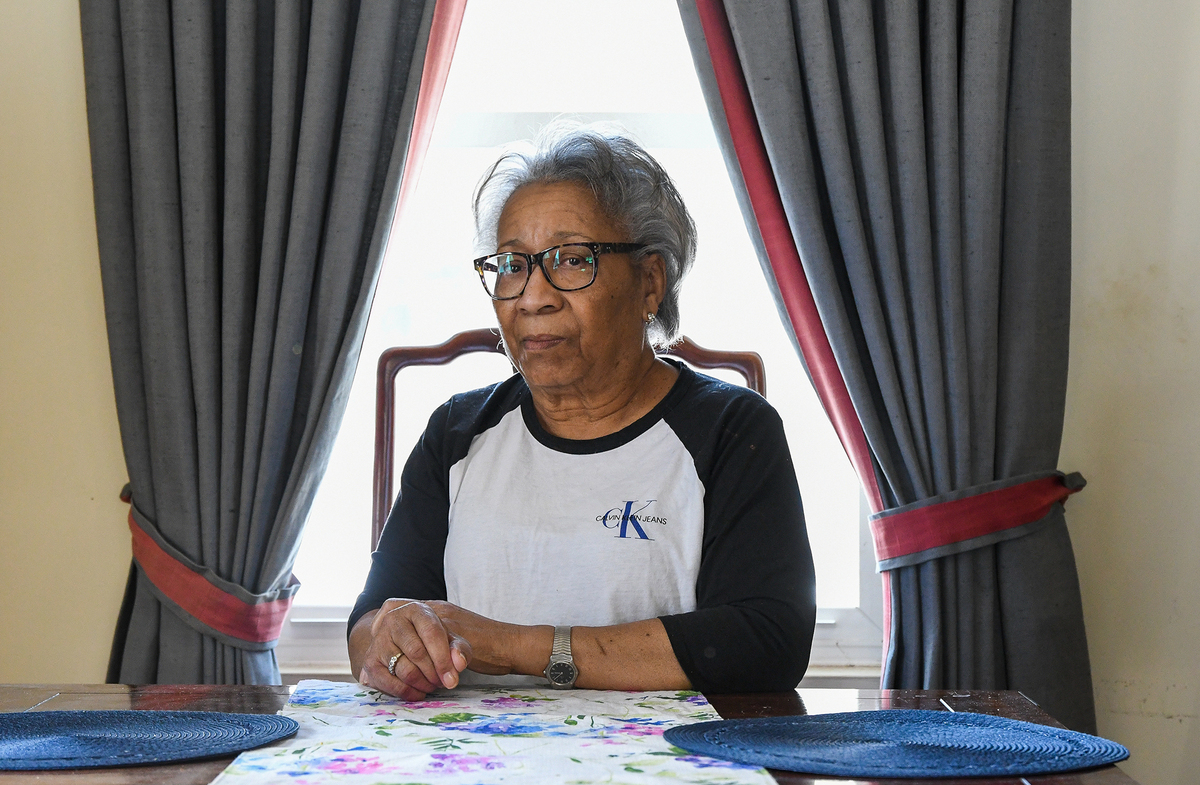
Lucille Brooks, a retiree who lives in Pittsford, New York, was sued in 2020 for nearly $8,000 by a nursing home that had taken care of her brother. The nursing home dropped the case after she showed she had no control over his money or authority to make decisions for him.
Heather Ainsworth for KHN
hide caption
toggle caption
Heather Ainsworth for KHN
Lucille Brooks, a retiree who lives in Pittsford, New York, was sued in 2020 for nearly $8,000 by a nursing home that had taken care of her brother. The nursing home dropped the case after she showed she had no control over his money or authority to make decisions for him.
Heather Ainsworth for KHN
ROCHESTER, N.Y. — Lucille Brooks was stunned when she picked up the phone before Christmas two years ago and learned a nursing home was suing her.
“I thought this was crazy,” recalled Brooks, 74, a retiree who lives with her husband in a modest home in the Rochester suburbs. Brooks’ brother had been a resident of the nursing home. But she had no control over his money or authority to make decisions for him. She wondered how she could be on the hook for his nearly $8,000 bill.
Brooks would learn she wasn’t alone. Pursuing unpaid bills, nursing homes across this industrial city have been routinely suing not only residents but their friends and family, a KHN review of court records reveals. The practice has ensnared scores of children, grandchildren, neighbors, and others, many with nearly no financial ties to residents or legal responsibility for their debts.
The lawsuits illuminate a dark corner of America’s larger medical debt crisis, which a KHN-NPR investigation found has touched more than half of all U.S. adults in the past five years.
Litigation is a frequent byproduct. About 1 in 7 adults who have had health care debt say they’ve been threatened with a lawsuit or arrest, according to a nationwide KFF poll conducted for this project. Five percent say they’ve been sued.
The nursing home industry has quietly developed what consumer attorneys and patient advocates say is a pernicious strategy of pursuing family and friends of patients despite federal law that was enacted to protect them from debt collection. “The level of aggression that nursing homes are using to collect unpaid debt is severely increasing,” said Lisa Neeley, a Massachusetts elder law attorney.
In Monroe County, where Rochester is located, 24 federally licensed nursing homes filed 238 debt collection cases from 2018 to 2021 seeking almost $7.6 million, KHN found. Several nursing homes did not file any lawsuits in that period.
Nearly two-thirds of the cases targeted a friend or relative. Many were accused — often without documentation — of hiding residents’ assets, essentially stealing. The remaining cases targeted residents themselves or their spouses.
Nursing homes have gone after some families for tens of thousands of dollars. In a few cases, debts surpassed $100,000.
In Monroe County alone, one nursing home sued the daughter and granddaughter of a former resident. The daughter pleaded with the court to release the granddaughter, promising she would pay the $5,942 debt. Another home sued a woman twice, for her husband’s and her mother’s debts. Yet another claimed a woman owed $82,000 for her mother’s care. The resident was, in fact, a cousin, according to court papers.
“I get calls all the time from people who are served with these lawsuits who had no idea that this was even a remote possibility, who call me crying and frantic,” said Anna Anderson, an attorney at the nonprofit Legal Assistance of Western New York who has represented defendants in such suits, including Brooks. “They believe not only that they’re going to lose their own income and their own houses and assets, but also they’re concerned that their loved ones who are still in the nursing home may be potentially kicked out.”
The legal strategy is often rooted in admissions agreements, the piles of paperwork that family or friends sometimes sign, not realizing the financial risks. “The world of nursing facilities is a black hole for most people,” said Eric Carlson, a longtime consumer attorney at the nonprofit Justice in Aging. “This happens in the shadows.”
In most cases reviewed by KHN, the people sued didn’t have an attorney, which can be expensive. In nearly a third, the nursing homes won default judgments because the defendants never responded, a common phenomenon in debt cases. In many cases, lawsuits sought interest rates as high as 18{c024931d10daf6b71b41321fa9ba9cd89123fb34a4039ac9f079a256e3c1e6e8} on top of the debt.
Long-term care officials and attorneys say they must use the courts when bills go unpaid. “It would be a disservice to the hospital’s residents, and to Monroe County’s taxpayers, to allow residents who have assets not to pay what is owed,” said Gary Walker, a spokesperson for Monroe County, which operates Rochester’s largest nursing home, Monroe Community Hospital.
From 2018 to 2021, the county filed 60 debt collection cases, including the lawsuit against Brooks, KHN found.
Nationally, Beth Martino, a spokesperson for the American Health Care Association, the largest nursing home industry group, said lawsuits against families are “not a common occurrence.”
But consumer attorneys in California, Illinois, Kentucky, Massachusetts, New York, and Ohio said they regularly see lawsuits against family and friends.
In 2020, Washington, D.C., secured an agreement with two nursing homes to stop what authorities called “deceptive billing practices.” The homes had sued at least 15 family members, the attorney general found.
Ahmad Keshavarz, an attorney who documented debt lawsuits around New York City, said nursing homes see adult children as more appealing targets than older residents. “Sons or daughters are more likely to have assets,” he said. “They have wages that can be garnished.”
In Ohio, Robyn King, a former teaching assistant from Cleveland, was sued for more than $70,000 by a nursing home where her mother had been a resident. “The lawsuit made no sense to me since I told them I would not be personally responsible for my mom’s medical expenses,” King told a U.S. Senate committee in March. “The stress was unbearable. I thought, ‘I will not be able to afford my mortgage.'”
Trapped by Paperwork
In upstate New York, Brooks faced a smaller yet shocking bill: $7,967.05.
“People like us live on a fixed income,” Brooks said. “We don’t have money to throw around, especially when you don’t see it coming.” She was so worried she didn’t tell her husband at first.
Brooks initially thought there had been a mistake. She and her brother, James Lawson, were part of a big family that moved north from Mississippi to escape segregation in the 1960s. Lawson, who was a gifted athlete despite losing an arm as a child, spent his career at the Rochester Parks and Recreation Department. Brooks worked in insurance. They lived on opposite sides of the city. “My husband is somewhat disabled, and that keeps me pretty busy,” said Brooks, who is also active in her church. “My brother always took care of his own business.”
“People like us live on a fixed income,” says Lucille Brooks of Pittsford, New York, who was sued for nearly $8,000 by a nursing home that had taken care of her brother. “We don’t have money to throw around, especially when you don’t see it coming.”
Heather Ainsworth for KHN
hide caption
toggle caption
Heather Ainsworth for KHN
“People like us live on a fixed income,” says Lucille Brooks of Pittsford, New York, who was sued for nearly $8,000 by a nursing home that had taken care of her brother. “We don’t have money to throw around, especially when you don’t see it coming.”
Heather Ainsworth for KHN
In summer 2019, Lawson was hospitalized after experiencing complications from a diabetes medication. The hospital released him to the county-run nursing home, and Brooks only found out a few days later. She visited her brother several times. No one talked to her about billing, she said. And she was never asked to sign anything.
After two months, Brooks’ brother went home. A year later came the lawsuit.
The county alleged that Brooks should have used her brother’s assets to pay his bills and that she was therefore personally responsible for his debt. Attached to the suit was an admissions agreement with what looked like Brooks’ signature.
Such agreements, which can run multiple pages, have long been standard in the long-term care industry. They often designate whoever signs as a “responsible party” who will help the nursing home collect payments or enroll the resident in Medicaid, the government safety-net program.
Many lawyers say making a family member financially liable is unfair. “If you bring your child to a doctor, you should pay for the child’s medical care. But if your adult child brings you to a nursing home and you’re 80, the law doesn’t bind you to pay those bills,” said Paul Aloi, a Rochester attorney who has represented all sides — patients, hospitals, and nursing homes — in debt collection cases.
Federal laws and regulations prohibit homes from requiring a resident’s relatives or friends to financially guarantee the resident’s bills. Facilities cannot even request such guarantees.
But consumer advocates say nursing homes slip the admissions agreements into papers that family members sign when an older parent or sick friend is admitted. Sometimes people are told they must sign, a violation of federal law. Sometimes there is barely any discussion. “They are given a stack of forms and told, ‘Sign here, sign there. Click here, click there,'” said Miriam Sheline, managing attorney at Pro Seniors, a nonprofit law firm in Cincinnati.
When Chris Ferris helped admit his mother to Kirkhaven nursing home in Rochester in 2019, he said, he asked the staff whether any papers he had signed made him financially liable for her care. “They said ‘no,'” he said.
Ferris, who was estranged from his mother, had no legal control over her finances. She had been managing her own affairs. Nevertheless, the nursing home sued Ferris two years later for nearly $11,000. “It’s not right,” said Ferris, who is no longer speaking with his mother.
In more than a third of the cases that nursing homes filed in Monroe County against friends and relatives, the people sued had no power of attorney, limiting their access to residents’ money to pay bills.
Accused of Stealing
Court records show Rochester-area nursing homes also frequently accuse family and friends of hiding residents’ money and property to avoid paying the debts. The allegation is known in debt law as “fraudulent conveyance.” But it is commonly interpreted by those being sued as an accusation of theft, which can be very frightening, consumer attorneys say.
The practice can intimidate people with means into paying debts they may not even owe, said Anderson, the legal assistance attorney. “People see that on a lawsuit and they think they’re being accused of stealing,” she said. “It’s chilling.”
Families do sometimes prey on older relatives, taking their bank cards or selling their property, advocates for seniors say. But nursing home lawsuits in Rochester contain almost no documentation to support these claims.
Monroe County provided supporting records in only three of the 29 lawsuits it filed that included a fraudulent conveyance claim against a friend or relative of a resident. And Underberg & Kessler, a Rochester law firm that has represented the county and other nursing homes, attached documentation in only five of the 70 actions it filed with such claims. The firm has filed the most nursing home debt cases in Monroe County.
Anna Lynch, a partner, said the firm always has “factual and legal grounds” to file. “The fact that the complaint does not make reference to the specific evidence does not mean there is not evidence,” she said. “When we do institute legal action on behalf of a nursing home, the firm reviews the agreements between the parties and the facts to make sure there are grounds for claims against the persons who are legally responsible for payment.”
Barbara Robinson, an 81-year-old widow who lives alone outside Rochester, said that wasn’t her experience. She was sued by Monroe County three years ago for $21,000.
Robinson, who lives on a fixed income, signed papers for an older friend who was admitted to the county home, and she said she helped staff gather information to enroll her friend in Medicaid.
“As far as I knew, that was that,” Robinson recalled. After the friend died, however, the county accused Robinson of taking her friend’s assets. The county provided no documentation.
Robinson said there was no money to take, noting that her friend “had spent every single dime.” A court ultimately dismissed the case, first reported by WHEC-TV in Rochester. Judge Debra Martin admonished the county for the lack of evidence. “Plaintiff must allege some facts to support its claims,” she wrote, noting that the county’s case “does not meet the bare minimum requirements.”
Ferris, who was sued over his estranged mother’s debts, had his case dropped by the nursing home. Valerie King Hoak, a spokesperson for the Kirkhaven nursing home, said the facility “cannot discuss private resident information or potential litigation with third parties.”
Brooks is now in the clear, too, after the county dropped its case against her. She said she thinks the signature on the admissions agreement was forged from the nursing home’s visitor log, the only thing she signed.
The experience left her shaken. She now tells anyone with a friend or relative in a nursing home not to sign anything. “It’s ridiculous,” she said. “But why would you ever think they would be coming after you?”
KHN (Kaiser Health News) is a national newsroom that produces in-depth journalism about health issues. Together with Policy Analysis and Polling, KHN is one of the three major operating programs at KFF (Kaiser Family Foundation). KFF is an endowed nonprofit organization providing information on health issues to the nation.